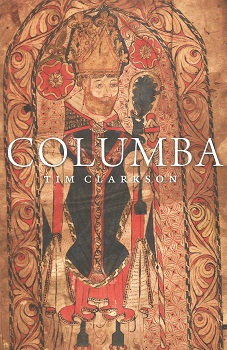
This is my fourth book, a biographical study of Saint Columba, the founder of Iona. Like my previous books it draws on primary and secondary sources to present a narrative history of its subject. In this case the main primary source (Adomnán’s Life of St Columba) is so central to the narrative that its author features almost as prominently as Columba himself. In fact, I’ve used Adomnán as my chief guide. My narrative sticks fairly closely to the Life throughout the first part of the book, which deals with Columba’s career in Ireland and Scotland. The second part looks at Columba’s legacy: the cult that grew around him and the federation of churches that regarded him as their patron.
One aspect of Columba’s story that particularly interests me is his interaction with secular powers, especially with ambitious rulers such as his kinsman Áed mac Ainmerech in Ireland, Áedán mac Gabráin of Dal Riata and the Pictish king Bridei. His relationships with these three, and with other powerful lords, are examined in this book, as are his dealings with folk of lesser social status.
Contents
Introduction: Finding Columba
Chapter 1 – The Sources
Chapter 2 – From Ireland to Iona
Chapter 3 – King Áedán
Chapter 4 – Abbot
Chapter 5 – Iona and her Neighbours
Chapter 6 – The Picts
Chapter 7 – Saint
Chapter 8 – Paruchia and Familia
Chapter 9 – Legacy
Like my second book The Men of the North: the Britons of Southern Scotland, this one has detailed references which are gathered into a Notes section at the rear, with an accompanying bibliography. Illustrations include maps and black-and-white photographs.
Columba is published in Edinburgh by John Donald. It is available from Amazon UK and Amazon US.
* * * * * * *

 Senchus
Just put it on my wishlist…
Thanks, Nicola. Amazon show it as being available Stateside on 1st November but I’m not sure if this is a definite date.
Thanks. I’m reading it.
Cheers, Ian. I’ll be interested to hear what you think of it.
Looks very interesting – requesting library order it ( yeah, I still use libraries…)
Cheers, Phil. It’s good to know libraries still have money for new books!
There’s some – we fight for it. And I’ve learned you should make sure they have your requests so when money is available.
Libraries need to survive – the world would be more dim with out them ( in all meanings of the word “dim”)
Well said! I totally agree.
[…] Clarkson of Senchus has announced his newest book of Columba, announced the latest issue of the Heroic Age , and wrote about searching for Bede’s […]
Flipping heck, Tim, it’s only five minutes since your last book or seems like it, how are you doing it? What’s next? 🙂 Congratulations, anyway!
Thanks, Jon. You’re right about the timing. Columba came hot on the heels of Makers Of Scotland. But no more books are in the pipeline at the moment, except for one or two vague ideas. At some point I need to tackle a couple of journal articles, and get back into gear with blogging, and read a whole heap of stuff.
I spent three days and two nights at the Argyll Hotel on Iona in June 2011. It was the most beautiful, magical place. Myself and three friends found the Monk’s Cell ruins, which was not easy! The history, the beauty, the peace was so overwhelming! I understand why it is considered a “thin place”. I will be looking for your book!
Yes, Iona has a special kind of atmosphere. If you pick up my book sometime, I hope you enjoy reading it.
I am currently reading, The Chronicles of Iona: Prophet, by Paula de Fougerolles, which is a fictional account of Iona and Columba. I have so many questions about which parts are true and which parts are pure fiction so next on my list will be your book.
Thanks again for your interest in my book, Teresa. I’ve not yet read the current two volumes in the Chronicles of Iona series but it will be interesting to see how the fictional narrative weaves among the historical fragments. On the factual side you’re on solid ground with Paula: she has a medieval history PhD from Cambridge and is an expert on the ecclesiastical politics of Brittany.
Not another one of your books I’m going to have to buy?! I think I should just get shares in you!
Cheers Mak!
Bought … reading … liking …
Thanks again Mak. I hope it turns up something useful for your own research. Our old friend Artur gets a namecheck at some point, although I didn’t give him a slot in the index.
I’ve come across old Artúr mac Áedán already and, yes, there is a great deal of useful information in your book Tim.
What I’ve found very interesting, with regards to my research, is your thoughts on why Aedan got his epithet ‘Wily’ or ‘Treacherous’ and the relationship between Dalriada and Alt Clut. As you know, it’s important for me because of just which Arthur the poem Y Gododdin is referring to? If that verse actually dates to the 6th century.
Yes, the context behind Áedán’s epithet is a mystery. Why he was remembered in North British (or Welsh) tradition as ‘Wily’ is anybody’s guess. I think Rhydderch of Alt Clut was probably his vassal at some point, but this may have been unconnected with his epithet.
I’m firmly with the camp that sees Arthur as a later Welsh interpolation in the Gododdin, added to the verse no earlier than the 9th century (assuming the verse itself originated in North Britain at an earlier date).
This is at the edges of my recollection, but isn’t Áedán given a slot in one of the Welsh Triads which is something like “three bad hosts” for pulling that old trope, murdering his enemies after inviting them to a feast? It’s not exactly an explanation so much as further proof of that reputation, even if I do recall correctly, I suppose. What’s your basis for the supposition about Rhydderch, Tim, is this something of yours I’d know if I’d read Men of the North yet? I’m sorry if so…
The theory Tim comes up with in his book is, because the other two mentions in the same Triad were just chastised for being bad guests, that this may have been the same for Aeden, rather than him attacking.
Jonathan – my current interpretation of the Welsh triad is as described by Mak. In a footnote in Columba I’ve credited James Fraser’s From Caledonia to Pictland for the idea. Previously, I regarded Áedán’s ‘unrestrained ravaging’ of Alt Clut as a military campaign, and was still attached to this idea when I wrote The Men of the North. Fraser pointed out that the other two Unrestrained Ravagings were abuses of hospitality by badly behaved guests (Arthur and Medraut) rather than raids by warbands.
This led to my my musing on the relationship between Rhydderch and Áedán. Here’s what I wrote in Columba:
‘One implied message in the Welsh triad is that the three hosts who endured the abusive behaviour were unable to prevent it. If Rhydderch invited Áedán as an honoured guest, and if Áedán then used the occasion to behave in an arrogant and boorish manner, we might infer that the political relationship between the two kings was unequal, and that Rhydderch was Áedán’s vassal.’
I sought slender support for this speculation in Vita Columbae, where Rhydderch’s correspondence with Columba on whether or not he will die in battle suggests (to me) that he feared Áedán and wanted reassurance from the latter’s High Priest that an army from Kintyre wouldn’t march against Alt Clut anytime soon.
[…] New book on Saint Columba […]